


Recent Reports and Data
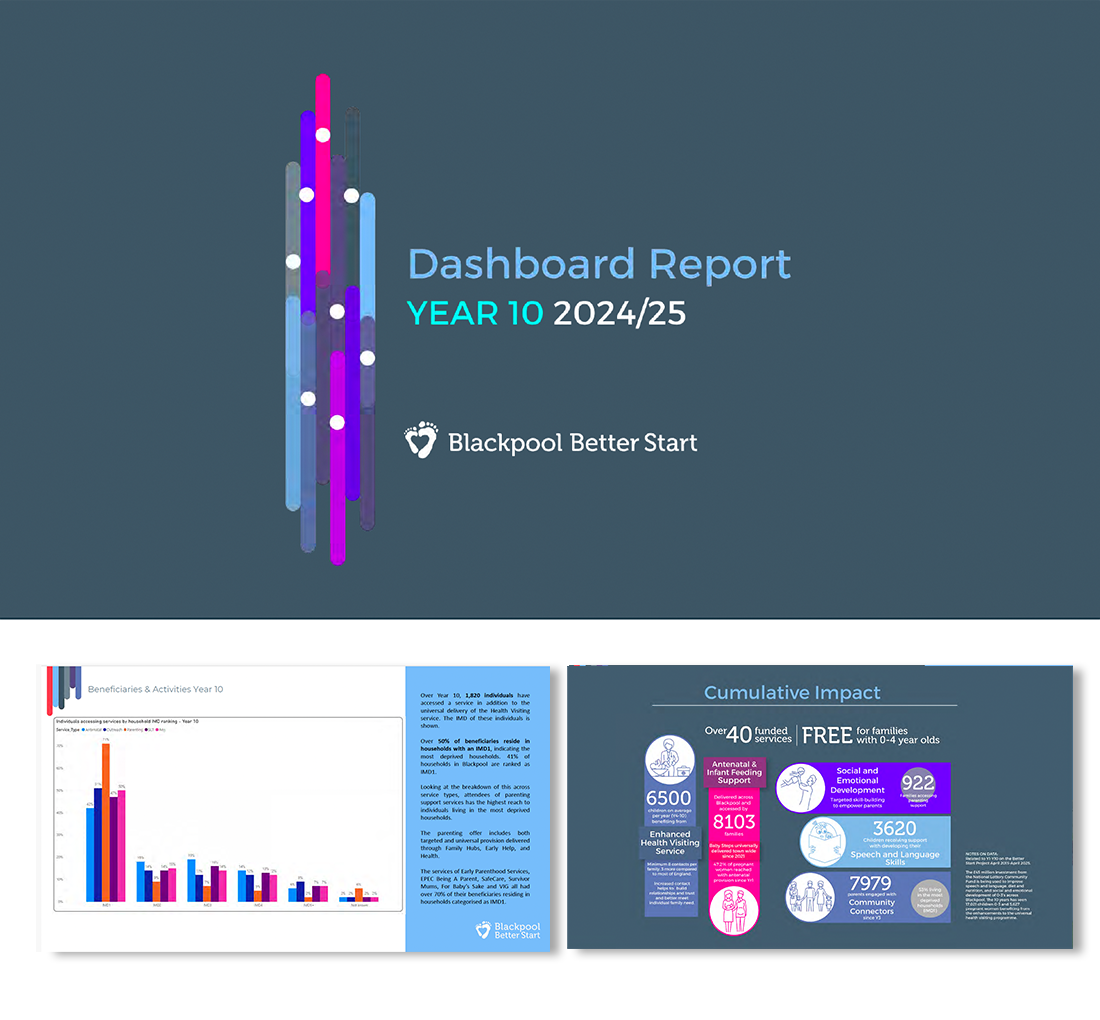
Annual Dashboard Report
The collection of good data and evidence are at the heart of Blackpool Better Start ensuring that the best interventions are delivered which meet the identified needs of communities and achieve the required impact. Ensuring the culture of knowledge generation is embedded will support the sustainability and legacy of Blackpool Better Start.
The Annual Dashboard presents a summary of:
• the activities undertaken within the year,
• who has benefited from services,
• support to the Early Years workforce,
• an overview of the selected population level outcomes and drivers giving insight into the landscape of needs of our community.
The Better Start outcomes reported in this dashboard were selected as indicators which measure child outcomes within the three overarching areas:
- Speech, language and communication
- Social and emotional development
- Diet and nutrition
Download full report as a pdf
Blackpool Better Start Timeline
Reflecting on what the programme has achieved and the learning it has provided so far.
View as as a pdf (8 mB)
Blackpool Better Start Reports
These reports have been written by the Centre For Early Child Development, on behalf of the Better Start Partnership, the reports are available for public distribution and use, any reproduction or inclusion of any of the content should give appropriate credit to the Better Start Partnership. These reports may not be used for commercial purposes without the permission of the Centre for Early Child Development and Better Start Partnership.
Building Systems for Early Childhood Development
Clare Law, Director of Better Start, and Chris Cuthbert of the Thomas Coram Research Unit, Social Research Institute, University College London, have written this insightful report on building effective systems that enable meaningful change.
Using Clare and Chris’s many year’s insight and experience in early child development and using learning from ten years of the Blackpool Better Start Partnership, this report explores the theme of building systems and how it differs from systems change – a term which hints at minor tweaks when major rebuilding is needed to improve outcomes for more young children.
Download Building Systems for Early Childhood Development as a pdf (7MB)
A good practice guide to support implementation of trauma-informed care in the perinatal period
Produced by: Clare Law, Dr. Lauren Wolfenden, Dr. Mickey Sperlich and Professor Julie Taylor,
Commissioned by: NHS England and NHS Improvement
First published: 19th February 2021
All staff can play a part in ensuring women and their families feel safe and secure in the care setting. This includes – but is not limited to – midwives, obstetricians, sonographers, anaesthetists, psychiatrists, psychologists, nursery nurses, mental health nurses and maternity support workers. The principles in this guide equally apply to non-registered staff, those in supportive or administrative roles and those who provide direct professional or clinical care, advice and support.
Blackpool Parent-Infant Relationship Service – Evaluation Report 2024
Blackpool PaIRS aimed to support individual parent-infant relationships, increase skills to support these relationships amongst early years professionals and to increase awareness of the importance of supporting PIR in policy and practice. The service was primarily implemented to work directly with parents and infants aged 0 to 2 years old (including antenatal support) delivering relationship focused interventions, whilst also working with CAMHS and Family Hubs to provide group support for parents and children aged 3-5years old. To raise awareness and skills around supporting parent infant relationships, PaIRS delivered training, engagement events and telephone consultations for early years professionals. Researchers at Blackpool Centre for Early Child Development carried out a feasibility and acceptability evaluation of Blackpool PaIRS in the first 14 months of delivery to families.
Guidelines for becoming a trauma-informed school
This guide provides a framework for staff on how to implement a trauma-informed approach within schools. It focusses on recognising and responding to trauma and supporting families and staff. The guide aims to share the science about the impact of trauma in an accessible format and provide some clear and practical tips for changes that can be made both by individual staff members, but also as a collective.
Download the Guidelines to being a trauma-informed school as a pdf (1MB)
Measuring What Matters
Scoping Review: The current use of outcome measures by Specialist Parent-Infant Relationship and Infant Mental Health Services
The aim of this review is to help guide good practice in evaluation of parent-infant relationship services and to provide practical solutions for future use.
Download the Measuring What Matters Scoping Review as a pdf (7MB)