


Meet the Team
Hello! We’re the Early Communication Team.
We support families of children who have been referred through the Blackpool Speech and Language Triage Panel. We are a referral-only service who help to support and develop your child’s communication skills through play-based learning and interactions, once a week for 10 weeks. We do this one-to-one in the home environment, as well as through our Discoverers stay and play speech and language sessions.
These sessions are invite-only, designed for children who have been referred into the Speech and Language Triage Pathway.
Pathway Overview
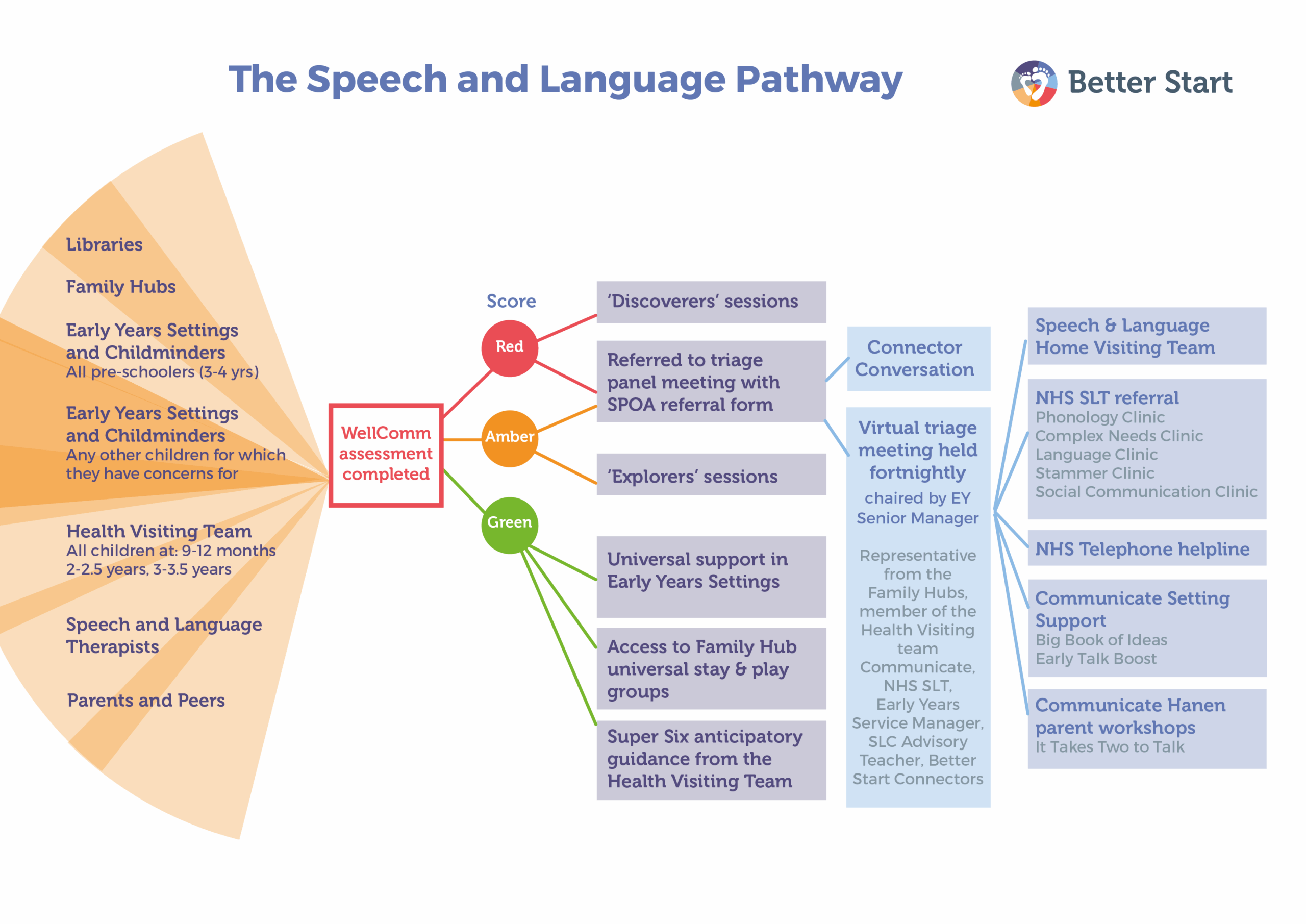
What to do if you are worried about a child’s
speech, language and communication development
Speak to parents/carers, do they share your concerns?
- Share the Super Six Parent/Carer card and seek consent to make a referral.
- You might need to share information and advice about SLC development to support parents/carers to give their consent.
- Visit www.speechandlanguage.org.uk/help-for-families/ages-and-stages
Early Years Practitioners in Settings:
- Speak to your Communication Champion.
- Complete a WellComm Assessment.
- If the child scores amber or red in their age-appropriate section, track the assessment back through the WellComm sections until the child had a green score.
- Refer to the Post WellComm SLC Triage Panel and attach all the WellComm score sheets, and refer to the tips at the bottom of this page. Download the forms: Click here
- Your Communicate SLTA can give you support and advice. Email: enquire@communicate-slt.org.uk
Childminders:
Access a WellComm kit and support (if required) to complete the assessment by emailing
enquire@communicate-slt.org.uk or earlyyearsslc@blackpool.gov.uk then follow the process above.
Health Visiting Teams:
- On completion of the WellComm at a Healthy Child Development Check visit please refer into the Post WellComm SLC Panel any child with a red or amber score.
- All children referred are offered support straight away from a Community Connector.
- They all receive an information pack including a picture book and will be discussed in less than two weeks upon receipt of referral where the panel will decide on the appropriate pathway.
- If parents/carers are reluctant for a referral or when the child is just amber (from green) in their age appropriate WellComm Section, leave the Super Six card for guidance and signpost them to the Explorers group in the Family Hub.
Wider Early Years workforce including Family Hubs, Early Help Teams and Library Staff:
Support and advice are available to you by emailing earlyyearsslc@blackpool.gov.uk
Please email if you think a child may have a speech, language and communication need and we can support with any referrals.
How to refer
Blackpool’s ‘Post WellComm Speech Language and Communication Triage Panel’ helps to put children forward on a pathway for referrals and interventions.
The panel brings together an NHS SLC Therapist; an SLC Therapist from Communicate; the local authority Early Years Team Manager; a literacy advisory teacher; and a Community Connector Co-ordinator from Blackpool Better Start.
If you would like to refer a child you are working with for consideration, download and complete the Referral Form here.
Please read the supporting tips at the bottom of this page to help with completion.
Reasons for Referral – Things to Think About
Attention and Listening
- What is their attention like at circle time and during activities (activities of their own choosing, adult-led activities)?
Understanding Language
- Do they have difficulty remembering information?
- Can they follow a story/conversation?
- Do they need short or simple instructions/gesture to help them understand instructions, do they need instructions repeating, what is their understanding of questions like?
Use of Language
- Are they trying to communicate and if so, how? – with gesture, sounds/babble, single words or linking words?
- What are they communicating to you? (requesting/what they need, what they’re interested in etc.)
- If they are using words- what kinds of words (names, action words, other), how many and how often (occasionally/frequently)
- How do they tell a story/explain events?
Speech Sounds
- Are there any sounds that they find particularly difficult?
- Can they be understood by familiar people/unfamiliar people?
Social Interaction and Play
- Do they initiate interaction (show you items of interest, bring you things to start a game/routine, or point thing out to others)? Do they respond to interactions?
- Do they play alongside other children, on their own, or with others? Do they have any difficulties taking turns or waiting for their turn with adults/peers?
- What do they like to play with and what kind of play do they engage in e.g. exploratory, repetitive, pretend, imaginative play?
- Describe their behaviour.
Other (stammering, voice, reluctant talking etc.)
- Stammering- is there any family history of stammering? How long has it been happening and has there been any changes over time? Is the child aware? What have you noticed when they stammer (repeating sounds or words, words getting stuck, physical movements)?
- Voice- are there concerns about the voice quality (hoarseness, croaky), frequent loss of voice?
- Reluctance-how does the child communicate at home vs in the nursery setting/in public? Do they look anxious or frozen when around unfamiliar people? Do they become upset when unfamiliar people are around or when transitioning to a different setting/leaving the house?
Supporting Tips for form completion
Contact details
Please complete as fully as possible, including your email address. This ensures that the decision letter can be sent out and you can easily be kept updated.
Child/young person’s details
Please ensure that the Date of Birth and address are filled in accurately.
Interpreter required
Please indicate if an interpreter is required to assess the child in their home language or to communicate with parents.
Mobile numbers
When discussing the referral with parents and gaining consent, it is worth checking that this is correct and hasn’t changed. All parents are contacted prior to triage to keep them updated, gather any further information needed and to ensure they understand the process.
Email address
A parent’s email address is helpful information to include as many of the services offered, such as Communicate, make contact through email.
Other professionals/services involved
This could be a social worker, family support work, NHS, Educational Psychology, Early Years Advisors, or Area SENDCO. It is useful to provide contact details if you have them.
Health/medical information and current medications
This could be hearing difficulties and concerns. Are the family awaiting any test results? Is there any history of frequent colds or ear infections?
History
As well as recording other family access to speech and language support or any other relevant information, it is helpful to know how many days the child is attending a setting as this can determine the outcome that is decided on. If a child is in nursery full time, e.g. it would not make sense to offer Home Visiting to the family.
Languages spoken at home
As well as recording other family access to speech and language support or any other relevant information, it is helpful to know how many days the child is attending a setting as this can determine the outcome that is decided on. If a child is in nursery full time, e.g. it would not make sense to offer Home Visiting to the family.
What advice/treatment/therapy/support has already been put in place and tried.
This may include support that are universally used in your setting, such as Hanen or Early Talk Strategies, modelling words and being face to face, or may be targeted such as Wellcomm “Big Book of Ideas” activities, Early Talk Boost.
Level of understanding of language/s spoken at home
Does the child use more words in their home language/languages?
Expected outcomes
You may wish to include whether the child’s parents would like information or support with their child’s S+L development.